

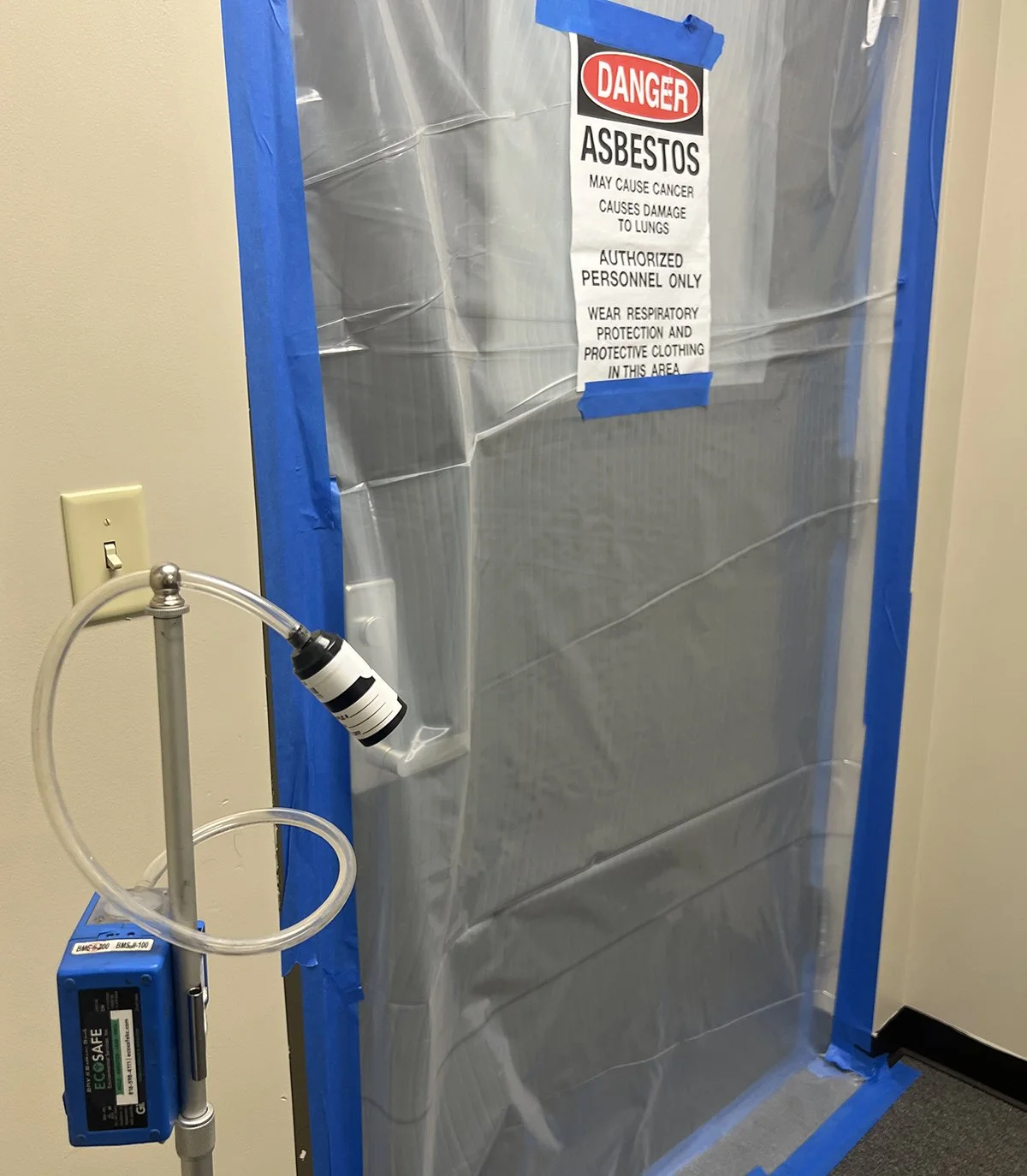
After asbestos is removed, final air clearance testing is the only way you can be certain your air is safe to breathe.
Why Final Air Clearance Testing Is Critical
After Asbestos Abatement
Removing asbestos-containing material is an important part of an abatement project, but evaluating the work area afterward matters, too. Final clearance combines a visual inspection with air sampling, when required or specified, to help determine whether the work area meets the project’s established completion criteria. It is an important verification step—not simply a final formality. EPA NEEPS
At EcoSafe Environmental Services, Inc., we support property owners and contractors through asbestos testing, air monitoring, consulting, and project oversight. When retained as the environmental general contractor, we coordinate qualified specialty subcontractors who perform the physical abatement work. EcoSafe does not self-perform asbestos removal.
What Is a Final Air Clearance?
Final air clearance testing evaluates airborne fiber concentrations after the abatement contractor has completed the required work and cleanup. Before sampling begins, a qualified professional visually evaluates the work area for dust, debris, and other conditions that need to be addressed. Air sampling is not a substitute for a satisfactory visual inspection. EPA NEEPS
Once the area is ready, air samples are collected using the procedures established for the project. The samples are analyzed, and the results are compared with the applicable clearance criteria. The required sampling approach, analytical method, and acceptance criteria depend on the regulations and specifications governing the work. For example, school projects subject to the Asbestos Hazard Emergency Response Act, or AHERA, have specific clearance requirements.
Why Does Final Clearance Matter?
It provides a documented check of post-abatement conditions. A visual inspection evaluates the cleanliness of the work area, while air sampling provides information about airborne fibers under the sampling conditions. Together, these steps support a more complete evaluation than either step alone. EPA NEEPS
It helps determine whether the project can move to the next stage. Where clearance is required, the applicable criteria must be satisfied before the work area is released. Under AHERA’s TEM clearance procedures, critical barriers remain in place until the clearance requirements are met. eCFR
It gives owners and contractors a record of the evaluation. Inspection findings, sampling information, and analytical results document what was evaluated and how the results compare with the project’s clearance criteria. This documentation is more meaningful than a general statement that an area “looks clean.”
PCM and TEM: Understanding the Difference
Two methods used to analyze asbestos-related air samples are phase contrast microscopy and transmission electron microscopy. They provide different information.
Phase Contrast Microscopy (PCM) counts fibers that meet the method’s counting criteria. It does not distinguish asbestos fibers from other types of fibers and cannot detect all asbestos fibers.
Transmission Electron Microscopy (TEM) can identify asbestos structures and detect smaller fibers that PCM may not resolve. It provides more specific information about asbestos in the sample. US EPA
The appropriate method depends on the project—not simply the fastest available turnaround. AHERA generally requires TEM for school clearance, while allowing PCM under specified circumstances. Other projects must be evaluated according to their applicable requirements and specifications.
What Does a Passing Clearance Result Mean?
A passing result means the evaluated work area met the applicable clearance criteria under the conditions and limitations of the inspection and sampling. It does not mean the entire building is asbestos-free, that every asbestos fiber has been eliminated, or that future air quality is guaranteed. Results must be interpreted in the context of the work area, sampling method, and project scope. eCFR
How EcoSafe Supports Property Owners and Contractors
EcoSafe provides asbestos inspection, air monitoring, visual evaluation, and project documentation services. Depending on project requirements and availability, we can provide on-site PCM analysis or coordinate TEM analysis through an appropriately accredited laboratory. Expedited options may be available and should be discussed before work is scheduled. EcoSafe
Our testing and consulting services are available separately from our environmental general contracting services. Property owners can retain EcoSafe to support a contractor they have already selected, and abatement professionals can work with us for technical support, monitoring, and documentation within the project’s requirements. EcoSafe
When EcoSafe serves as the environmental general contractor, our role is to coordinate the project, provide technical guidance, and oversee the work performed by qualified abatement subcontractors. We value our relationships with specialty contractors and structure our involvement to complement their work, with clearly defined responsibilities.
Clear Roles and Independent Verification
Clearance arrangements must address any applicable independence requirements. For example, AHERA requires TEM clearance sampling to be performed by qualified individuals who are completely independent of the abatement contractor. EPA explains that an abatement firm cannot satisfy this requirement simply by hiring its own testing subcontractor; the school must select an independent provider. US EPA
For this reason, we recommend establishing the clearance provider’s role and contractual relationship during project planning—not waiting until removal is complete. When EcoSafe is engaged to manage an abatement project, the clearance arrangements must be evaluated in light of that management role and the requirements governing the work.
Plan for Clearance Before Abatement Begins
Before work begins, discuss the clearance scope, testing method, inspection requirements, anticipated turnaround, and documentation with your project team. Identify who will perform the clearance evaluation and allow time to address any findings before scheduling subsequent trades or reopening the work area.
Planning an asbestos project or need air monitoring support? Contact EcoSafe Environmental Services, Inc. to discuss asbestos testing, clearance evaluations, contractor-support services, or abatement project management.
Don’t assume the air is clean—prove it.
Contact EcoSafe Environmental Services for reliable certified final clearance testing.
Call (816) 598-4111 or visit EcoSafeKC to learn more!

©2026 EcoSafe Environmental Services, Inc. | Kansas City, MO 64106 | (816) 598-4111